
No two young children develop in exactly the same way.
One child may communicate confidently but take longer to feel comfortable in group activities. Another may enjoy physical play while needing additional encouragement with language. These differences are a normal part of childhood development.
The challenge for educators is understanding what they observe and deciding how to respond appropriately.
Quality childhood education in Dubai therefore depends not only on delivering activities but also on recognising individual learning needs and adapting experiences without placing unnecessary labels or expectations on young children.
Observation Is More Than Watching Children Play
Professional observation has a purpose.
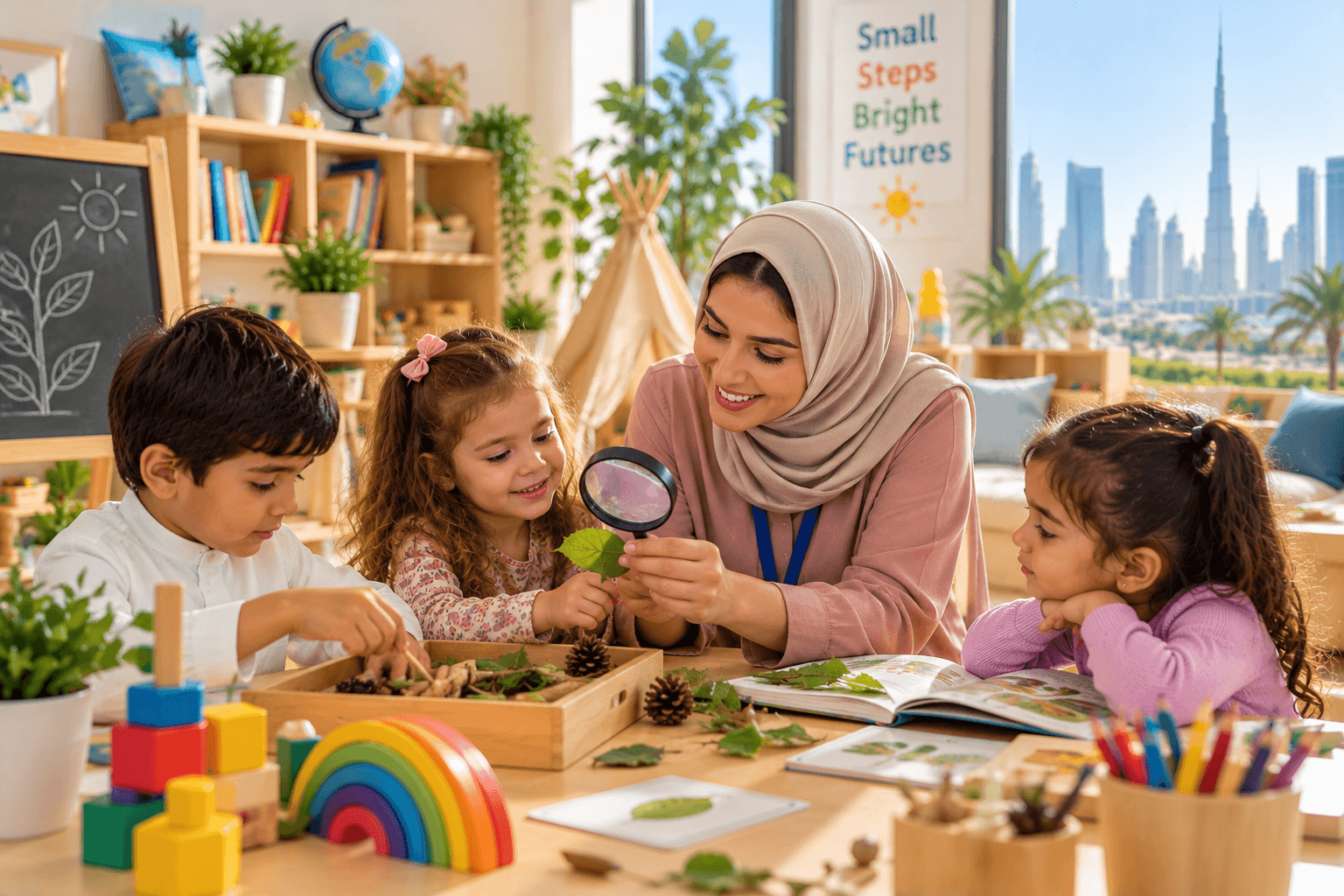
Educators watch children during natural activities to better understand how they communicate, interact, solve problems and respond to different situations.
A single moment rarely provides enough information. Patterns become more useful when practitioners observe children across different activities and times.
For example, a child who remains quiet during a large group session may communicate confidently while playing with one friend. Looking at the wider context helps educators avoid making conclusions based on one situation.
Observation therefore provides a starting point for understanding rather than a final judgement.
Understanding Development Provides Important Context
Educators need knowledge of child development to interpret what they observe.
Physical, cognitive, language, social and emotional development are connected, but progress does not always happen evenly across every area.
Professional training helps practitioners understand developmental expectations while recognising individual variation.
The NCFE CACHE Level 3 qualification described by IQE Academy prepares learners to work with children from birth to five and develop knowledge relating to children aged five to seven.
This developmental knowledge can help educators make more informed decisions when planning learning opportunities.
Interests Can Reveal How a Child Learns
Children frequently communicate their interests through the activities they repeatedly choose.
A child fascinated by vehicles may spend considerable time arranging toy cars, drawing roads or talking about journeys. Rather than seeing this repetition as a limitation, an educator can use the interest to introduce broader learning.
Counting vehicles can support early mathematics. Creating signs can introduce mark-making. Building roads can encourage spatial thinking and cooperation.
Following interests does not mean allowing children to do only what they already enjoy. It means using existing curiosity as a bridge toward new ideas and abilities.
Planning Should Respond to What Educators Discover
Observation becomes valuable when it influences practice.
If an educator identifies an emerging skill or particular challenge, future activities can be adjusted accordingly.
This is one reason rigid planning can be unsuitable for young children. Plans provide direction, but practitioners need enough flexibility to respond to what children demonstrate.
IQE Academy’s existing discussion of CACHE Level 3 and professional childcare practice explains how observation can inform future planning and support.
Responsive planning keeps learning connected to children rather than forcing every learner through an identical experience.
Adaptation Does Not Mean Lowering Expectations
Supporting individual needs is sometimes misunderstood as making learning easier.
Effective adaptation is different.
The objective is to remove unnecessary barriers so a child has a meaningful opportunity to participate. One learner may benefit from visual prompts, another from additional time, and another from completing an activity in a smaller group.
The learning intention can remain valuable while the route toward it changes.
This approach recognises that equality does not always mean providing everyone with exactly the same experience. Sometimes children need different forms of support to engage with the same broader learning opportunity.
Emotional Wellbeing Influences Participation
Learning is difficult when a child does not feel secure.
A change in behaviour may sometimes relate to tiredness, transitions, family circumstances or discomfort rather than an educational difficulty.
Educators therefore need to consider emotional wellbeing when interpreting participation.
Predictable routines and supportive relationships can help children feel secure enough to explore. Practitioners can also give children language for emotions and demonstrate appropriate ways to communicate frustration.
Understanding the whole child prevents educators from viewing learning needs purely through academic performance and supports a more balanced approach to development.
Parents Can Add Context Educators Cannot See
An educator sees a child within an educational environment. Parents see the same child in a different context.
Bringing these perspectives together can reveal useful information.
A parent might explain that a child frequently tells detailed stories at home despite rarely speaking during group activities. Alternatively, an educator may notice social behaviours that are less visible within the family environment.
Constructive communication allows both sides to share observations without turning every difference into a concern.
IQE Academy’s article on strong parent-educator partnerships provides further reading on this relationship.
Documentation Helps Build a Clearer Picture
Memories can be selective, particularly in busy early learning environments.
Appropriate documentation helps practitioners review observations over time and identify patterns more accurately. Records may demonstrate progress that is difficult to notice from day to day or show that a particular behaviour appears only in certain circumstances.
Documentation should always have a professional purpose and follow the policies of the educational setting.
The goal is not to create paperwork for its own sake. Useful records support planning, professional discussion and communication while helping educators make decisions based on evidence rather than vague impressions.
Knowing When Additional Support May Be Needed
Educators are not expected to independently diagnose every developmental or learning concern.
Their role includes observing, documenting, following professional procedures and communicating appropriately when additional support may be beneficial.
This distinction matters.
Making assumptions can create unnecessary anxiety, while ignoring persistent concerns may delay useful support. Practitioners need to understand the boundaries of their role and know when to involve appropriate colleagues or specialists according to their setting’s procedures.
Professional training can strengthen this judgement by helping educators understand both child development and their responsibilities within a wider support system.
Inclusion Benefits Every Child
Inclusive practice is not valuable only for children who require additional support.
When educators use flexible communication, varied activities and accessible resources, the entire group can benefit.
Children also learn from being part of a community in which differences are treated naturally and respectfully. They encounter different ways of communicating, solving problems and participating.
IQE Academy offers a dedicated NCFE CACHE Level 3 SENCO Award for Early Years that focuses on SENCO responsibilities and strategies for supporting children and families.
Professional Knowledge Makes Observation More Meaningful
Anyone can notice that two children behave differently. Professional knowledge helps an educator ask better questions about why those differences might exist and what response would be appropriate.
This is where education and training become particularly important.
At IQE Academy, early years programmes provide pathways for learners seeking to strengthen their understanding of professional practice. Rather than treating observation, safeguarding, inclusion and child development as unrelated subjects, aspiring educators benefit from understanding how these areas interact during everyday work with children.
That connection between knowledge and practice is central to becoming a reflective early years professional.
Supporting the Individual Without Losing Sight of the Child
Individualised support works best when educators continue to see the child rather than only the area where help may be required.
Children have interests, relationships, strengths, personalities and changing emotions. A difficulty in one area should not become the defining feature of their educational experience.
Thoughtful childhood education in Dubai combines observation with developmental knowledge, family communication, inclusive planning and professional judgement. When educators use these elements together, they can respond to individual needs while preserving curiosity, confidence and belonging.
The aim is not to make every child develop in the same way. It is to create conditions in which each child has a meaningful opportunity to participate, learn and progress.